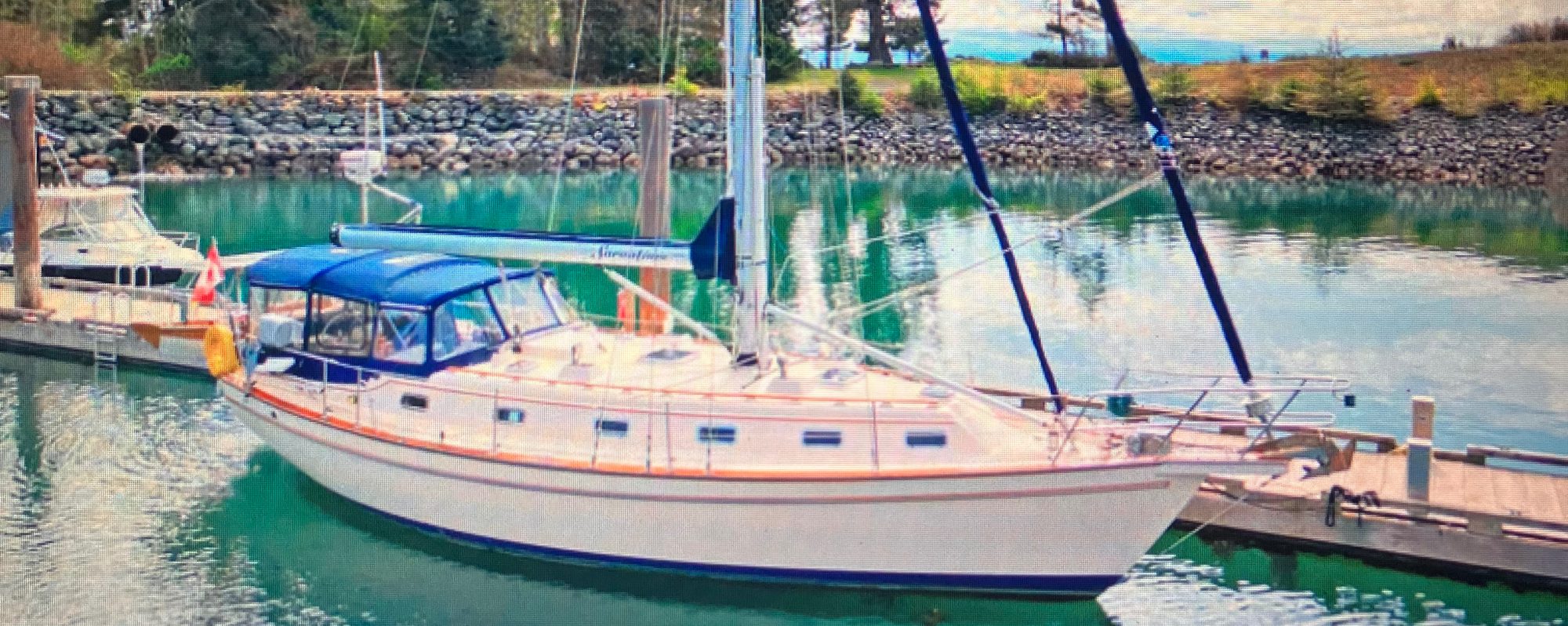
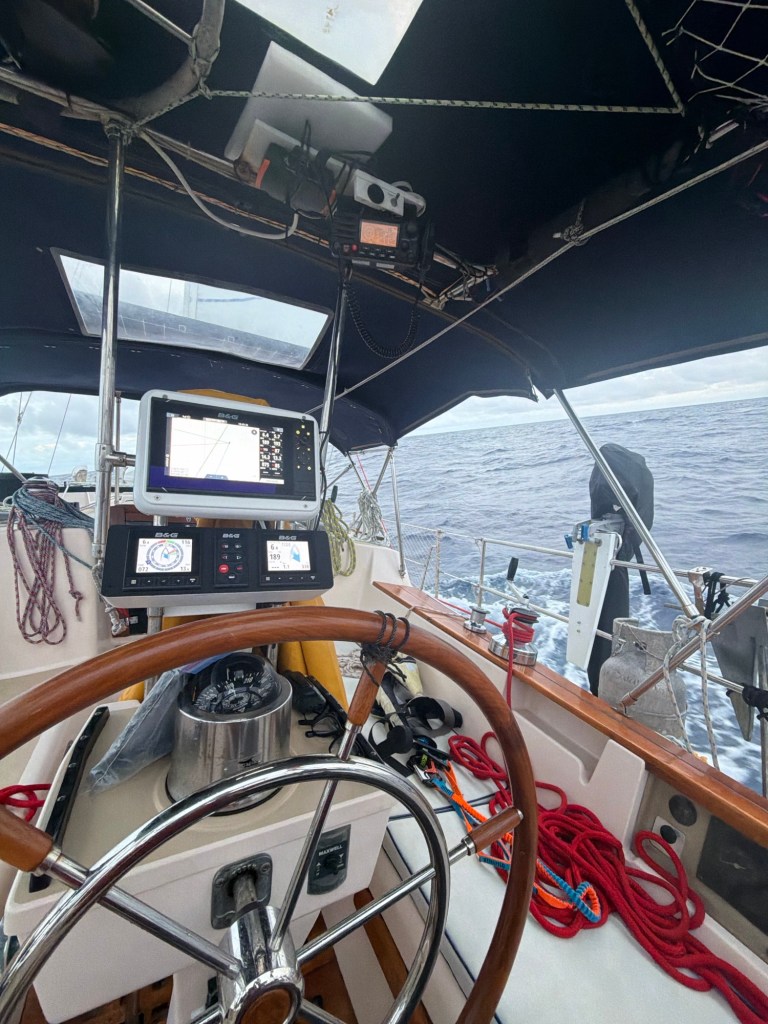
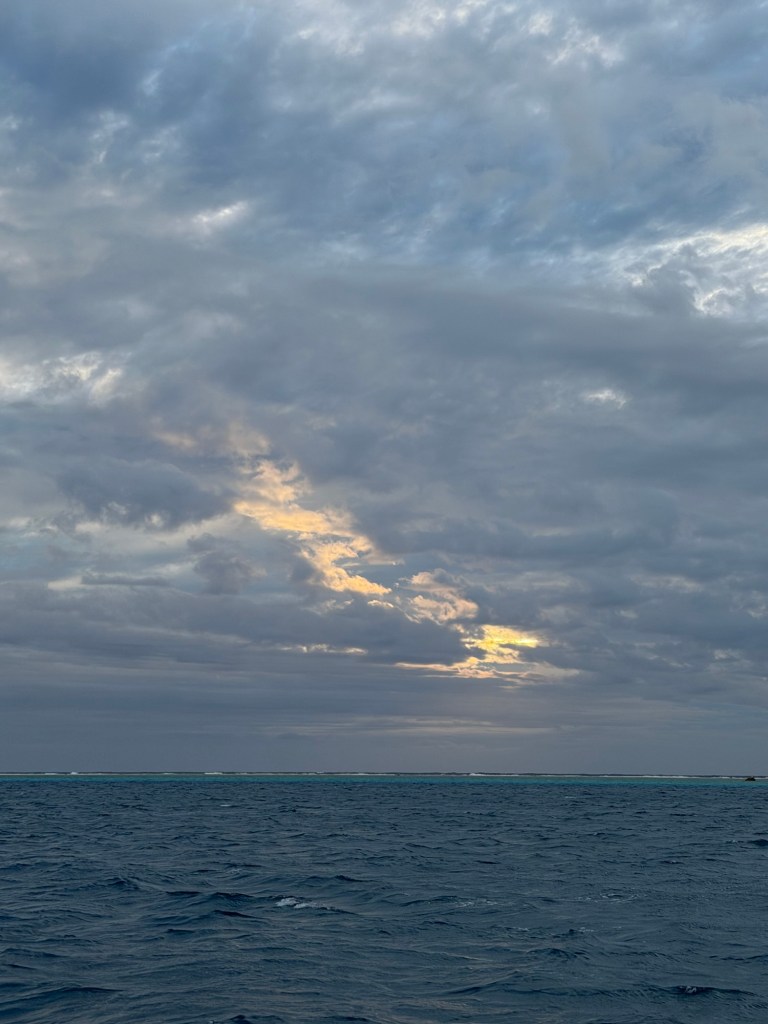
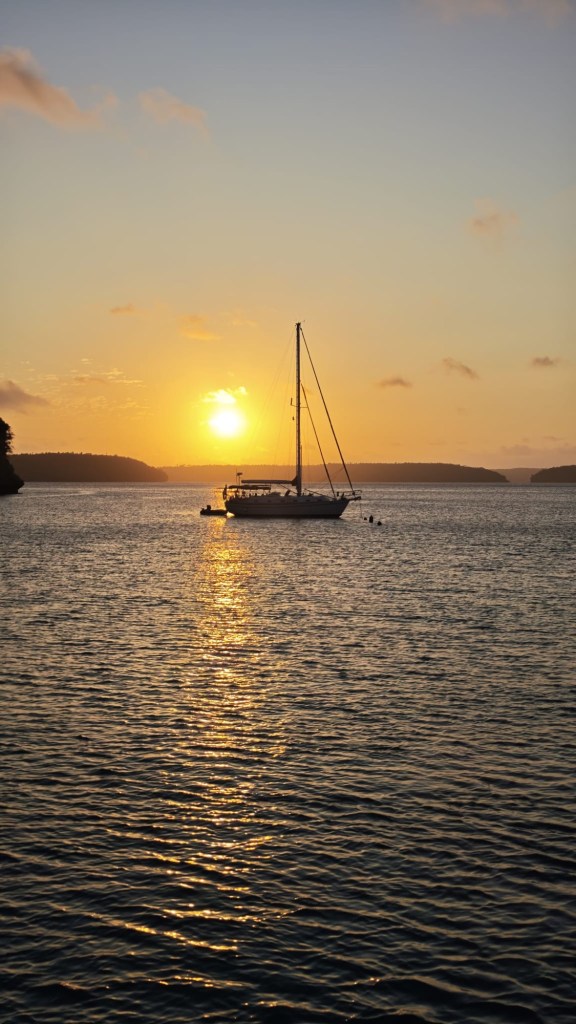
The second night of this crossing was a fast one. Sarantium kept a solid 5.5 kt on average. Most of the morning was much the same until noon when the wind dropped to 7 kt and then to 4kt. Big swell made it uncomfortable and the noise from slapping sails was enough to drive me nuts so I turned on the motor and went below to do some cleaning. Within two hours I noticed rain and wind picking up. Quickly Sarantium was in what I thought was a squall, however this lasted for hours. Rain, southeasterly winds at 26-30 kn and gusts lasted for 8 hours. The rain soaked three sets of clothing. Needless to say I am exhausted! So I’ll say Goodnight from a wet and rolley South Pacific.
Goodmorning, still lots of wind but now only 28-20kn. I’ve managed to set the heading at 210° so heading southwest towards New Zealand! This feels good!
I slept surprisingly well during my first night! I’m usually up all night checking the plotter and tweaking the sails whether they need it or not. Nerves! Last night I set all my alarms and slept well for one and two hours at a time.
Hopefully tonight will be the same!
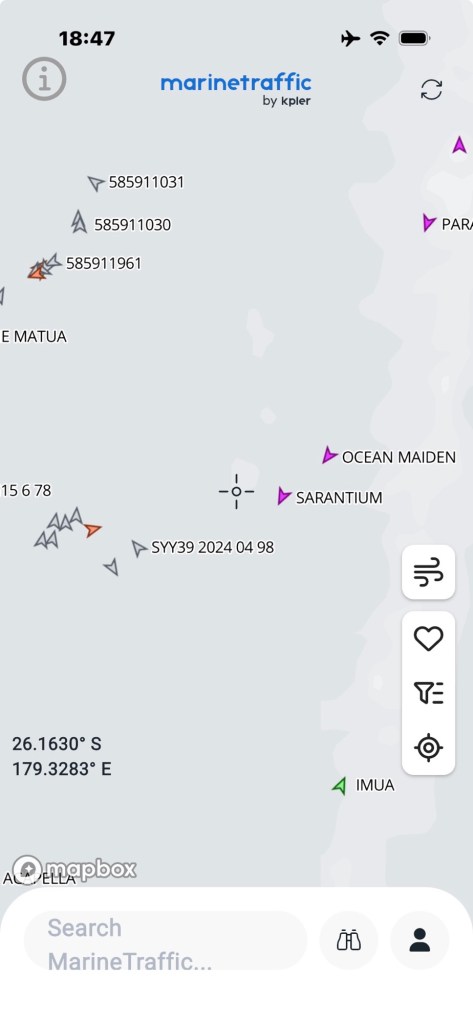
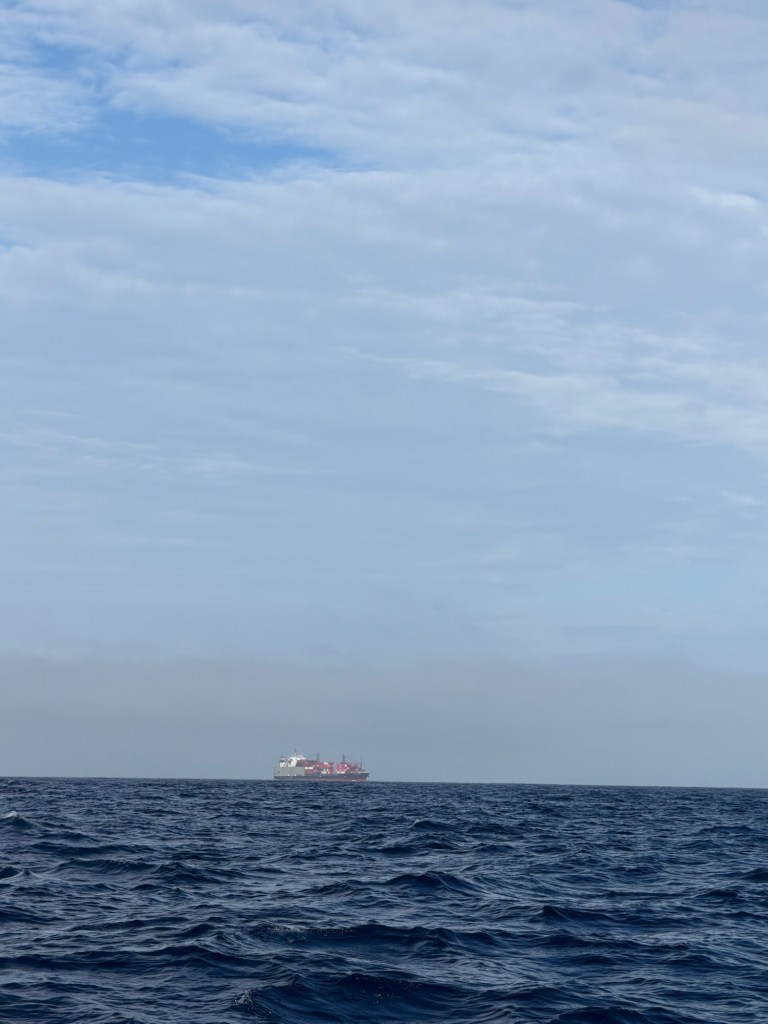
There is a Chinese fishing fleet just west of me that I’m keeping an eye on, but they seem to just be floating around!
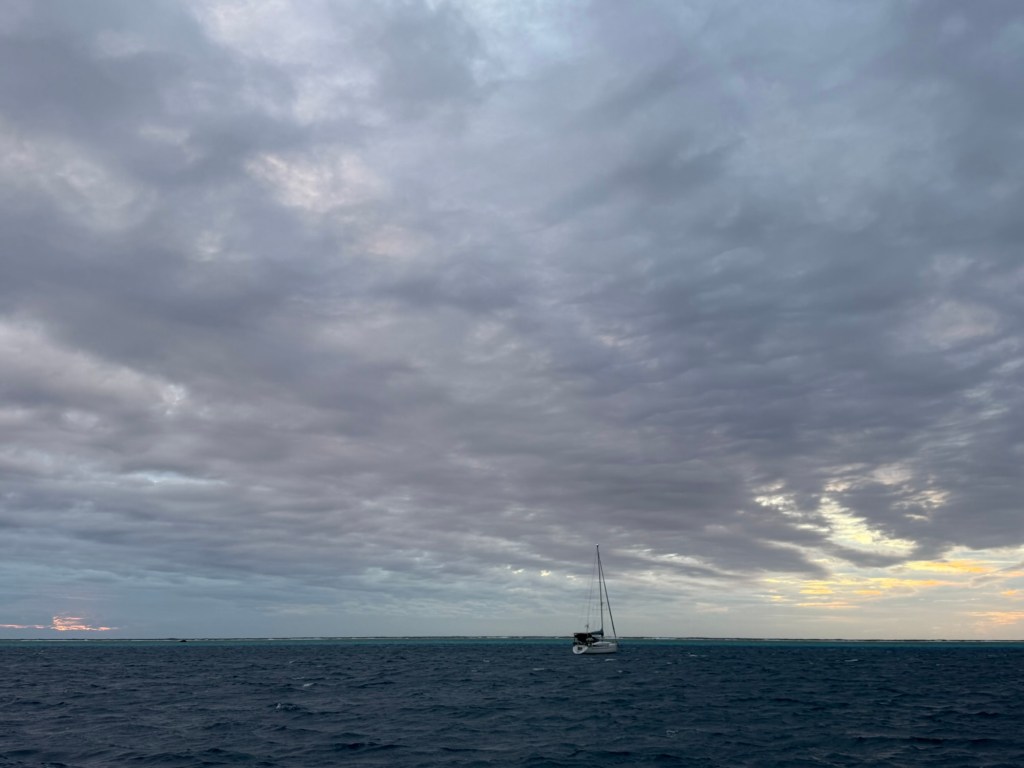
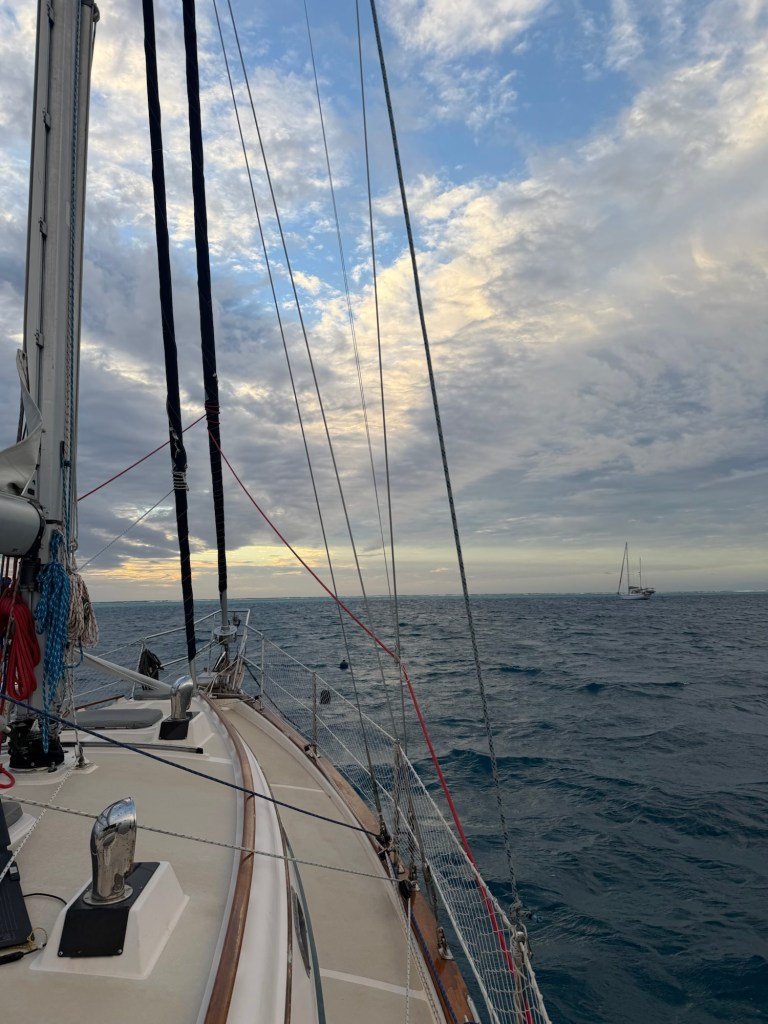
No tankers, no ferries, no cargo ships… just Ocean Maiden and Sarantium side by side!
…pulling anchor and all the preparations are done.
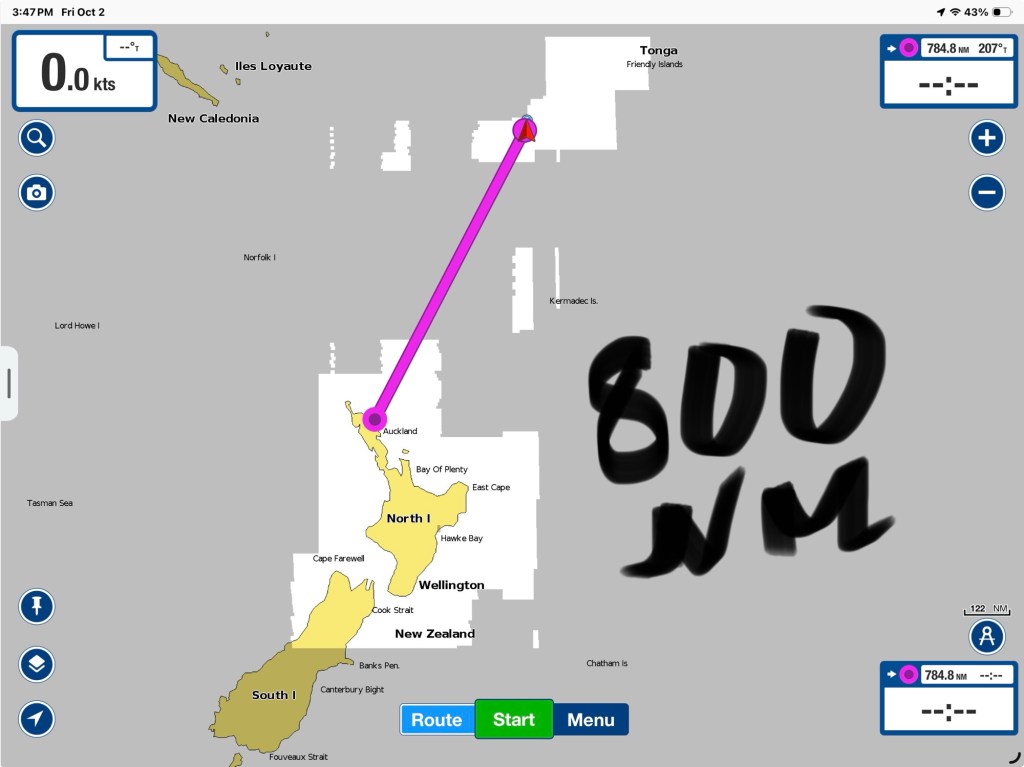
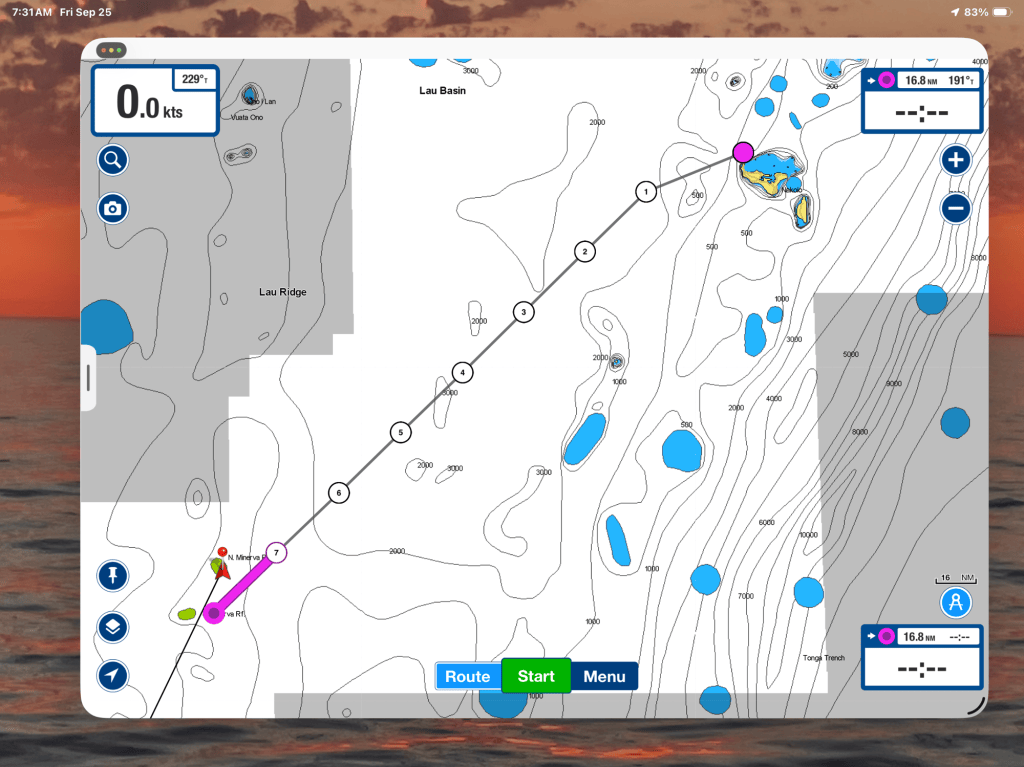
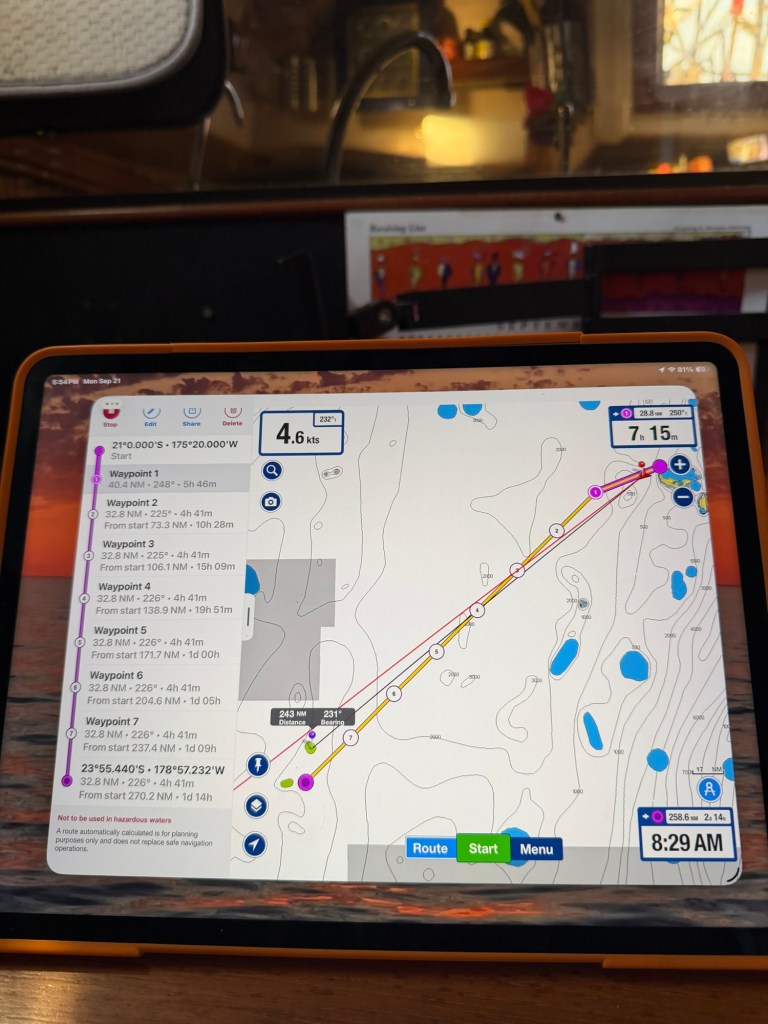
It looks like a direct route to OPUA, NZ. I’ll be keeping a 206°TRUE heading right to landfall. M
Magnetic heading will vary throughout the voyage. Leaving Minerva I’ll keep 193°, mid passage around 190°, and approaching landfall around 187°.
The forecast looks good and I am excited for my last leg of the South Pacific for the year.
There is a trough today north of Norfolk. It is travelling South East and I might encounter its rain clouds on Sunday evening but just a ESE winds at 15kt for starters and 20kt gust. The trough/low then peels off to SE of my path. The wind is expected to swing to North East, 15kt, from there on in. Peak swell will be 2.3m 9 seconds apart from ESE at the start. This is what MET BOB says…
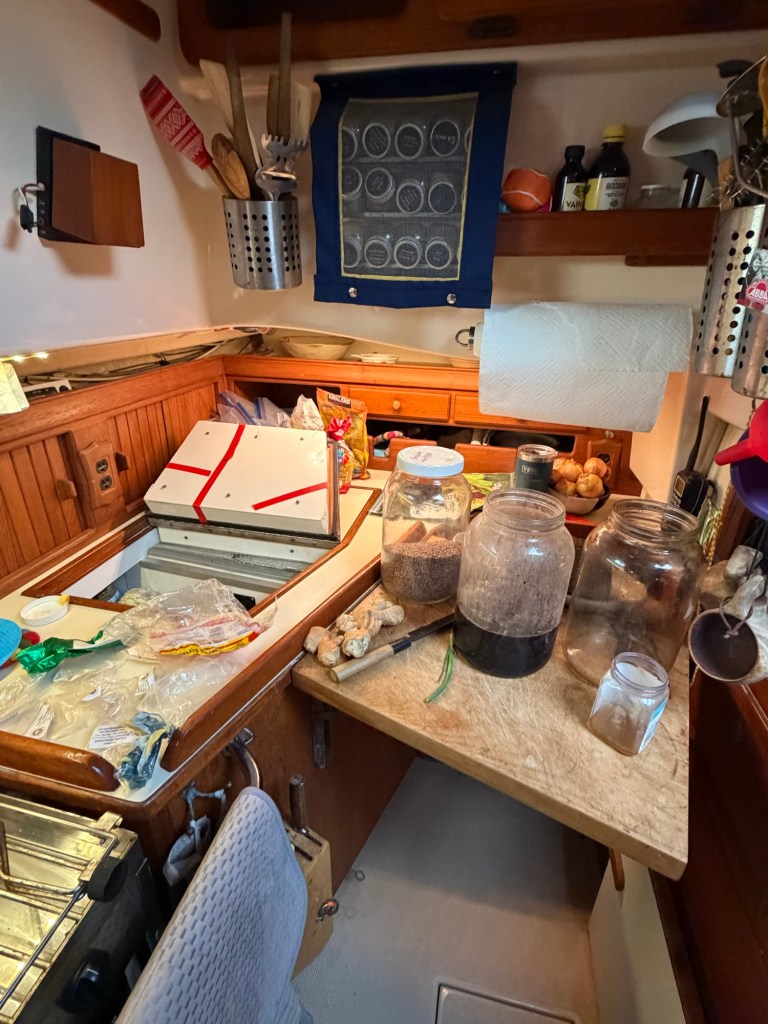
Today, I’ve been going through the boat making sure everything is tied down and put away.
Meals are prepped and unwanted food (NZ guidelines) has been tossed out. I’ve dug out my wool and fleece clothing for the cooler temperatures.
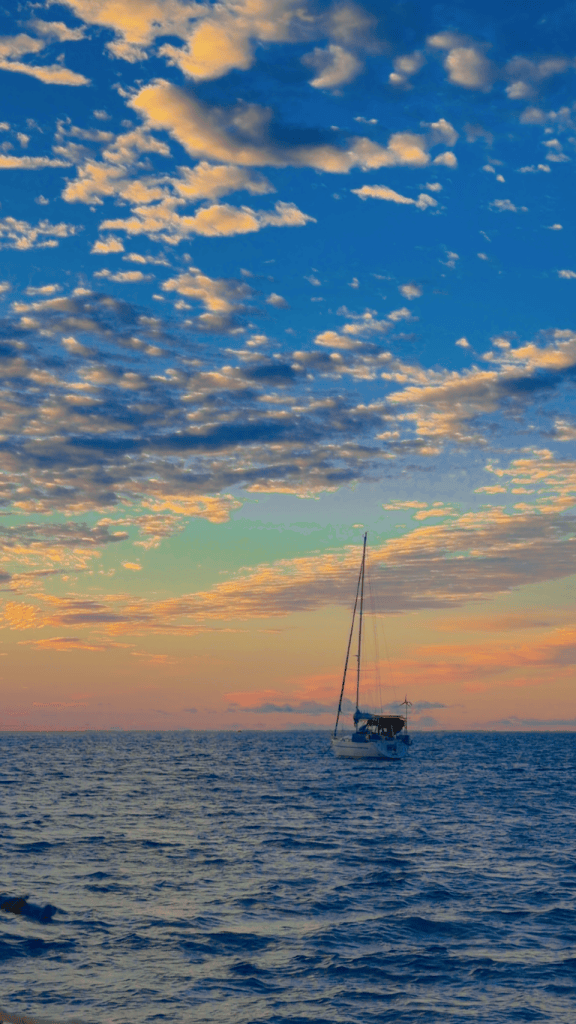
Ocean Maiden! One of the last mornings here in Minerva Reef…
There’s a lot to organize, toss, clean, and check off. Coming into a country with a small vessel is not quite as straightforward as arriving by plane. And honestly, I’m glad countries are this thorough when it comes to letting people and their sailboats through their borders.
When entering New Zealand by air, you need to present an NZeTA (New Zealand Electronic Travel Authority), as well as complete the required declaration. The declarations for a small vessel are a bit more involved, naturally, because they’re particularly concerned about pests and other biosecurity risks.
Luckily, my ant collection from when I was hauled out in Apataki has starved to death and is now extinct. My lizard, Liz, hasn’t been seen for some time either, so I’m hoping she has also moved on. She might have eaten all the ants and then found another boat.
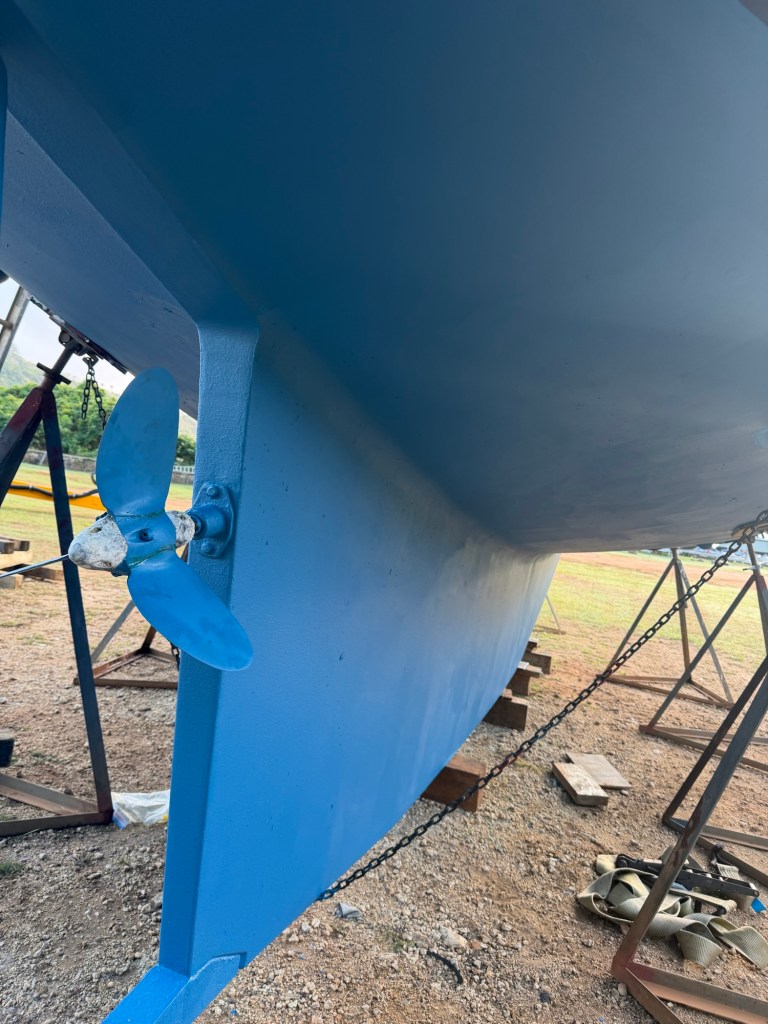
New Zealand has very strict biosecurity policies in place. They’re concerned about both soft and hard growth on the boat hull below the waterline. This is one of the reasons I hauled out in Tonga and antifouled the bottom.
New Zealand wants current proof that the bottom of the boat is clean, so I’ve been filming underwater and sending the clips to Biosecurity. And I just received an email that they accepted my photos and I’m approved to enter into NZ without further investigation of the boat hull.
There’s also a long list of food restrictions. Certain foods simply cannot be brought into the country, so I’ve been tossing opened packages and will continue to get rid of fresh fruit and vegetables before arriving.
It’s a mess…. plastic plastic plastic, my biggest pet peeve… A matter of profound concern to me. I have been scooping out plastics underway when I see some…. gives me a hobby when out there on the big blue ocean.
It’s a lot of preparation, but I understand why they take it seriously. New Zealand is remarkably protective of its environment, and when you arrive by boat, you’re bringing your entire little ecosystem with you.
In addition, I’ll need to get the boat through customs and receive an import customs number. This will come in very handy as I plan to refit Sarantium and spend a ton of money. And hopefully there will be a tax break as I am a “boat in transit”. I’ve also applied for a visa in case I need to stay longer. All of these applications have taken a significant amount of time, so staying here at Minerva Reef a little longer has been useful.
The forecast for departure looks good this Friday. In the meantime, I’ll continue wiping down the boat inside and out, exploring the reef, and sharing dinners with my cruising friend Silke aboard Ocean Maiden. Silke has been sailing solo since 2013.
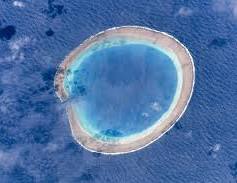
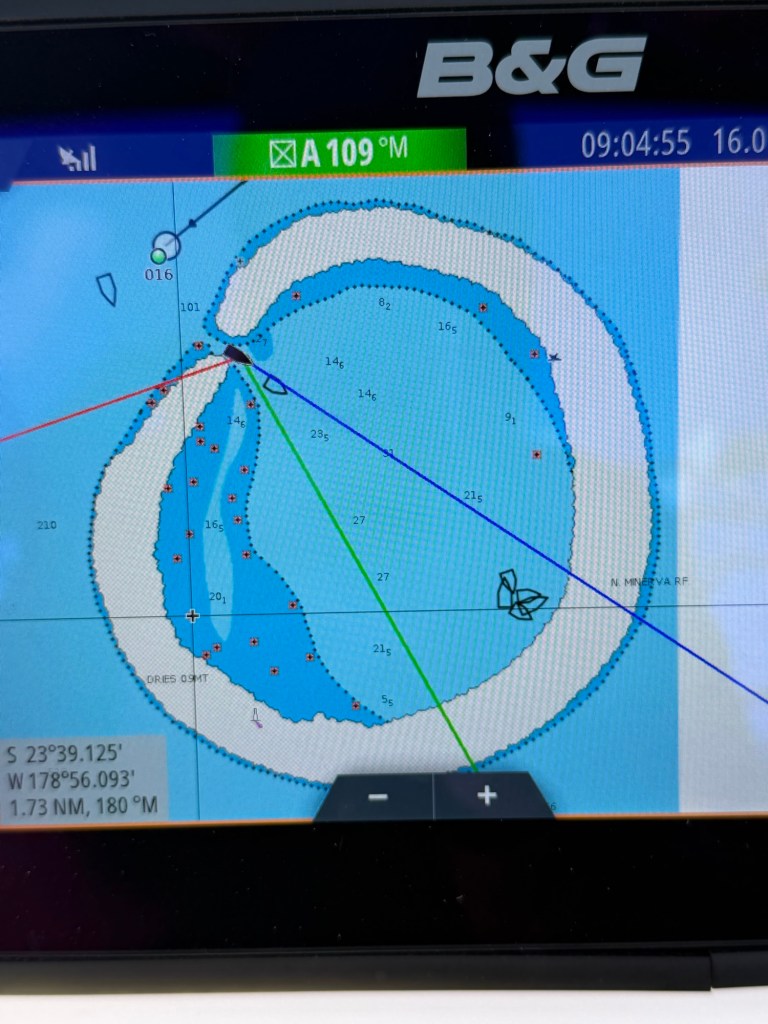
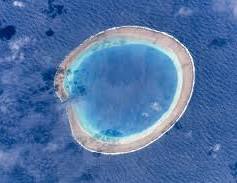
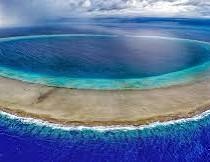
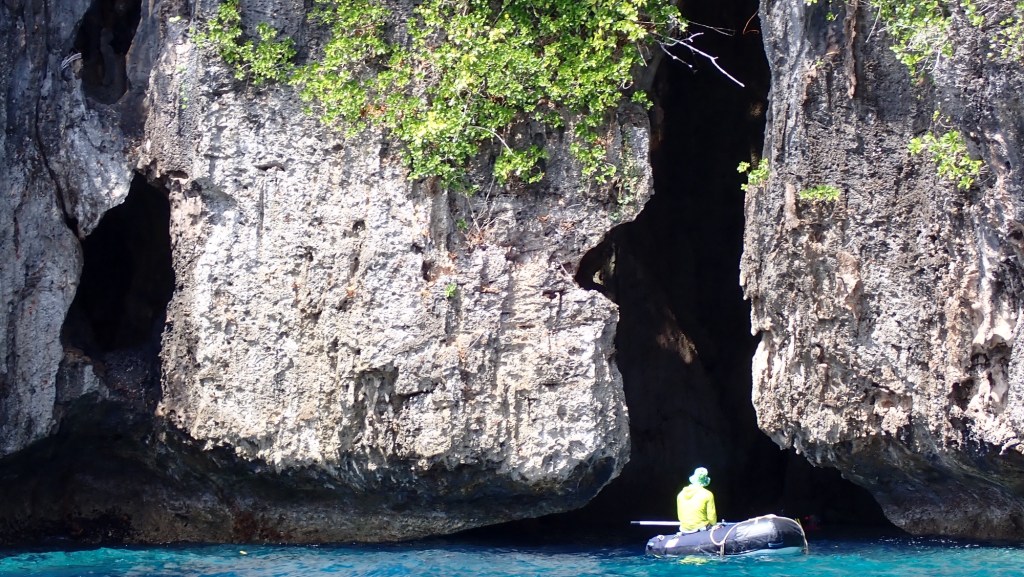
… a place one can only arrive to by boat. Minerva Reef lays 260 nmiles from Tonga and 800 nmiles from New Zealand. Minerva Reef is completely inhabited and has for the most parts been left untouched. There are a few wrecks and as imagined sailors have been beach wrecked and stranded here throughout history. One story that comes to mind is a boat-full of men in 1962 who ran aground here and were stranded for months before found. If you’re interested to learn more there was a documentary made of this story, which sounds fascinating. I have yet to watch it.
The plan…
🍾🍾🍾🍾🍾🍾🍾🍾🍾🍾🍾🍾🍾🍾🍾🍾🍾🍾🍾🍾🍾🍾🍾
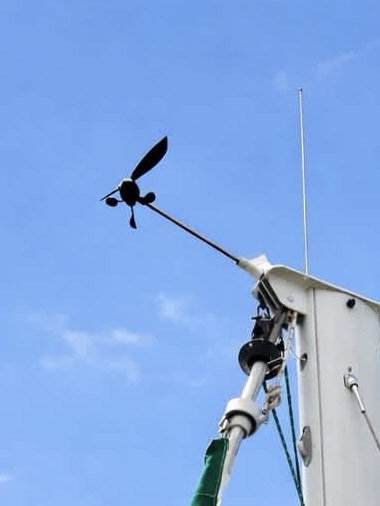
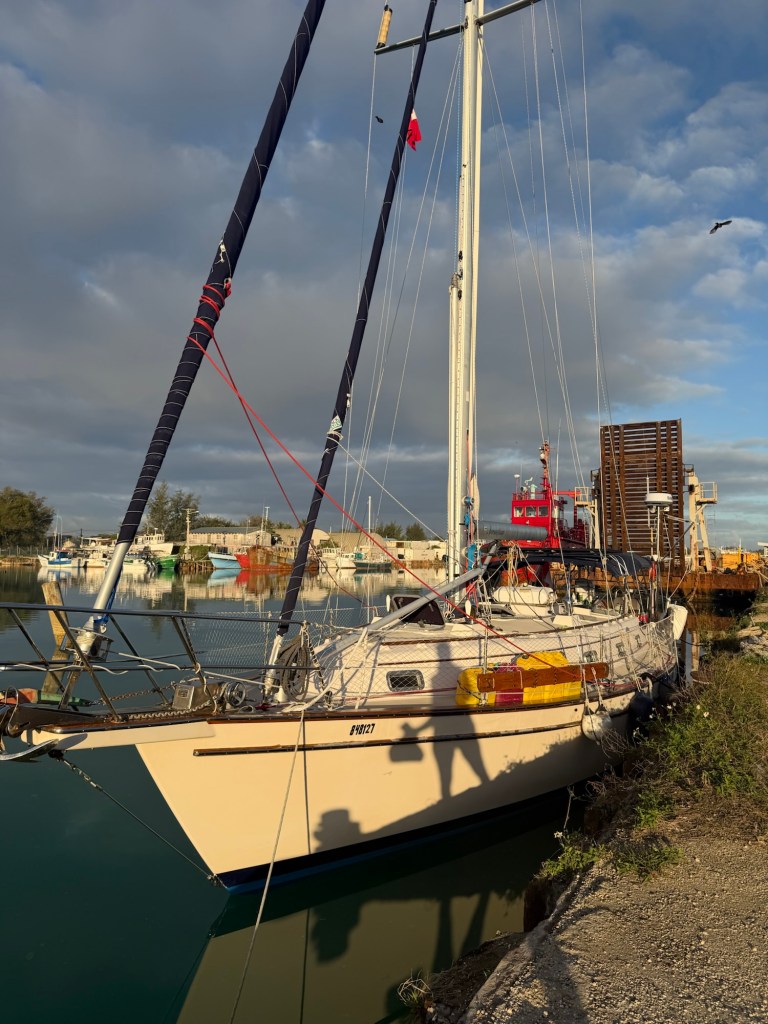
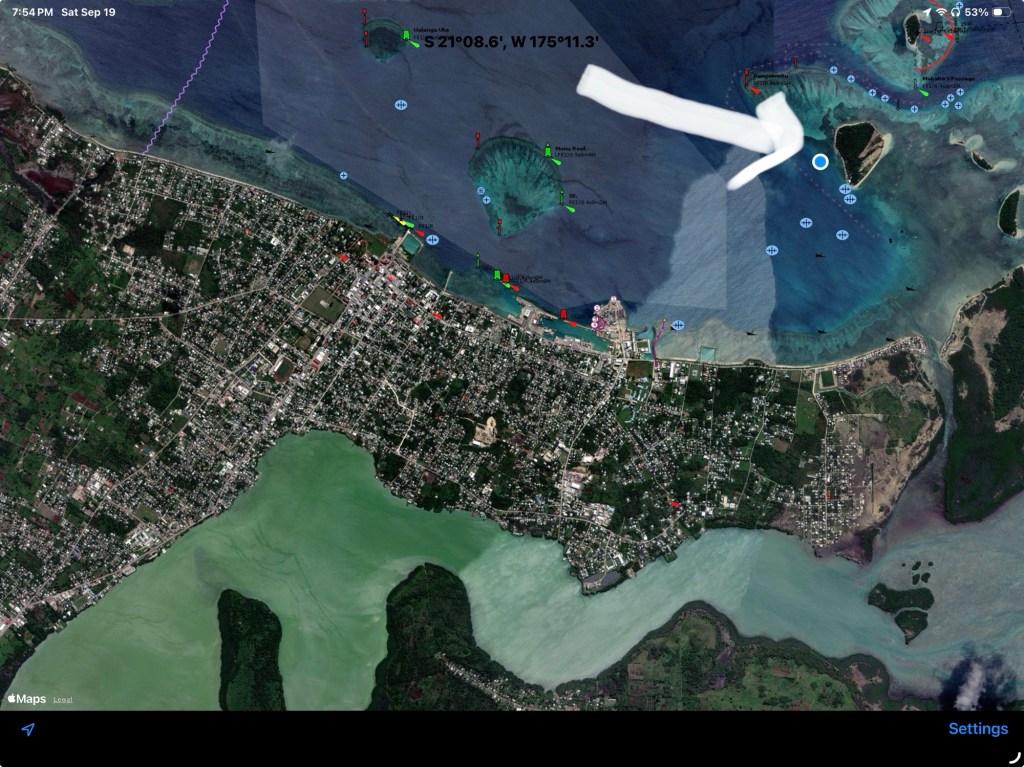
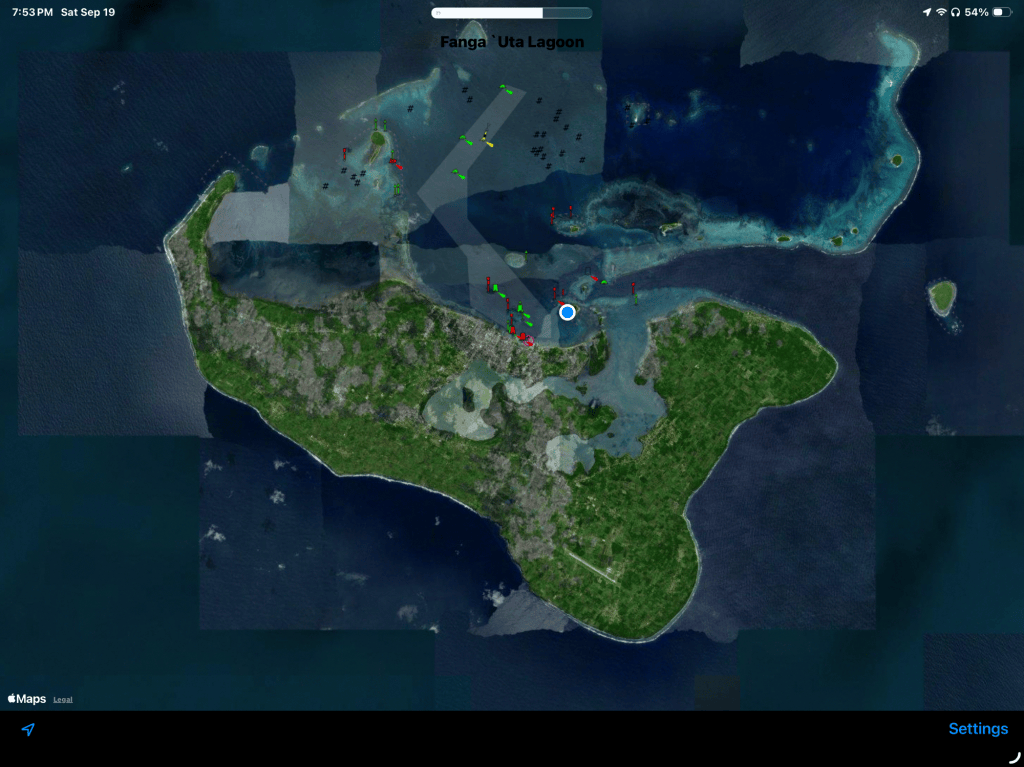
After receiving and installing the new B&G wind sensor, I finally pulled anchor at Pangaimotu Island, just outside Tonga’s capital, Nuku’alofa.
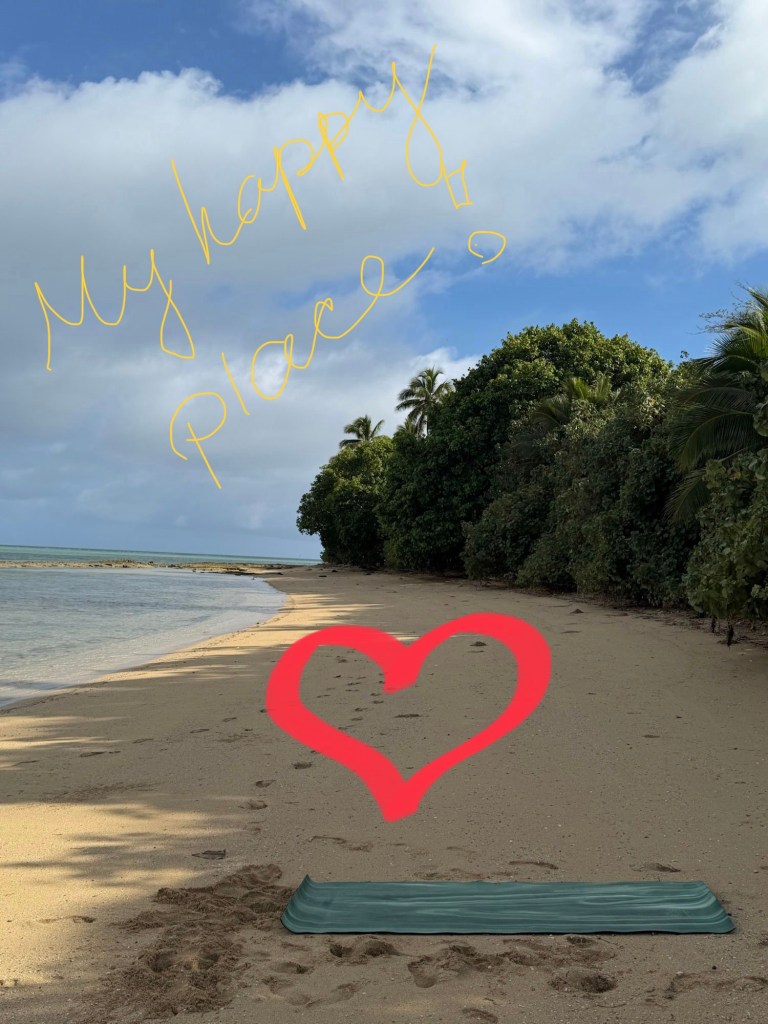
A family of four once ran a resort on this little island. Four years ago, a tsunami destroyed it. They are slowly rebuilding, piece by piece, but for now the resort is far from fully operational. The two sons run a small ferry between Nuku’alofa and the island, carrying visitors who come for the beach, the nature, and, perhaps most of all, the family’s warmth and hospitality.
Sundays are particularly special.
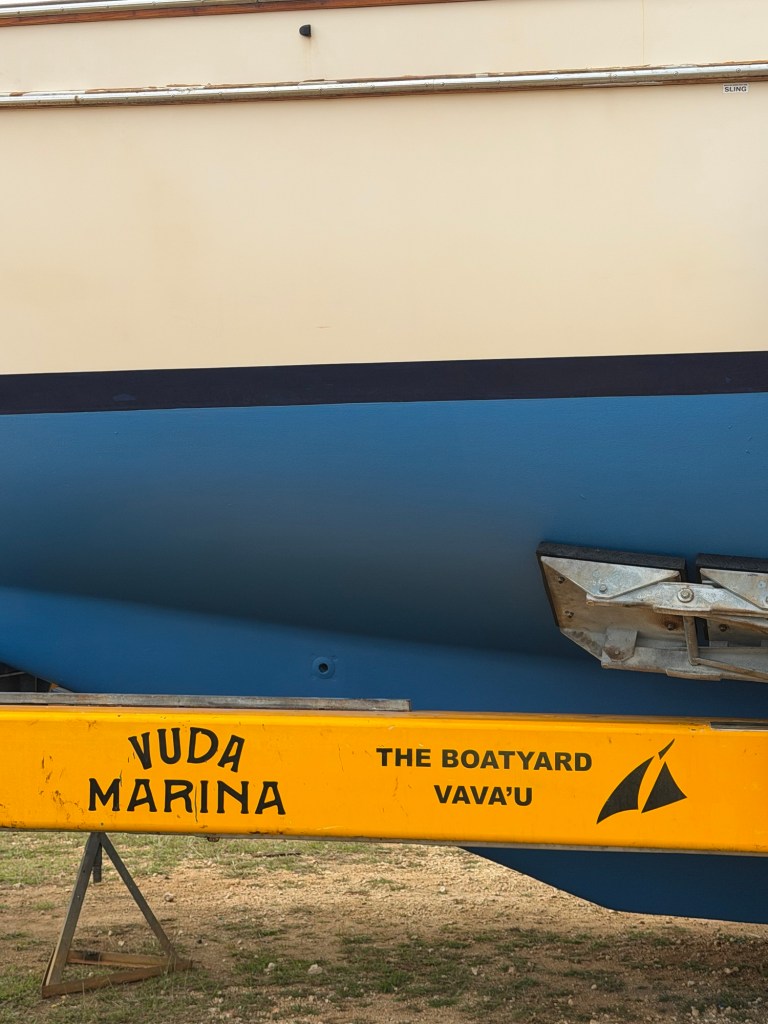
For the most part, Sunday in Tonga remains a day for church in the middle of the morning, followed by time with family and friends. As I understand it, there are also laws restricting work on Sundays, whether paid or unpaid. I experienced this myself at the boatyard in Vava’u when I was trying to paint. Every now and then, the police would turn up to make sure nobody was working on their boat.
The entire country seems to exhale.
Working life stops. People rest. They visit each other, eat together, go to church, and simply spend time together.
I like this.
Perhaps because it reminds me of growing up in Sweden, when Sundays were quiet and most, if not all, things were closed. It was simply understood that one day of the week belonged to family, friends, and being together. Children played. There was no expectation that everything had to be available all the time.
It amazes me how difficult the Western world seems to find this idea today. The thought of closing stores for one day a week, or giving employees a genuine day off, can seem almost radical.
Convenience, production, and performance have won the race.
But perhaps we have forgotten what we were racing towards.
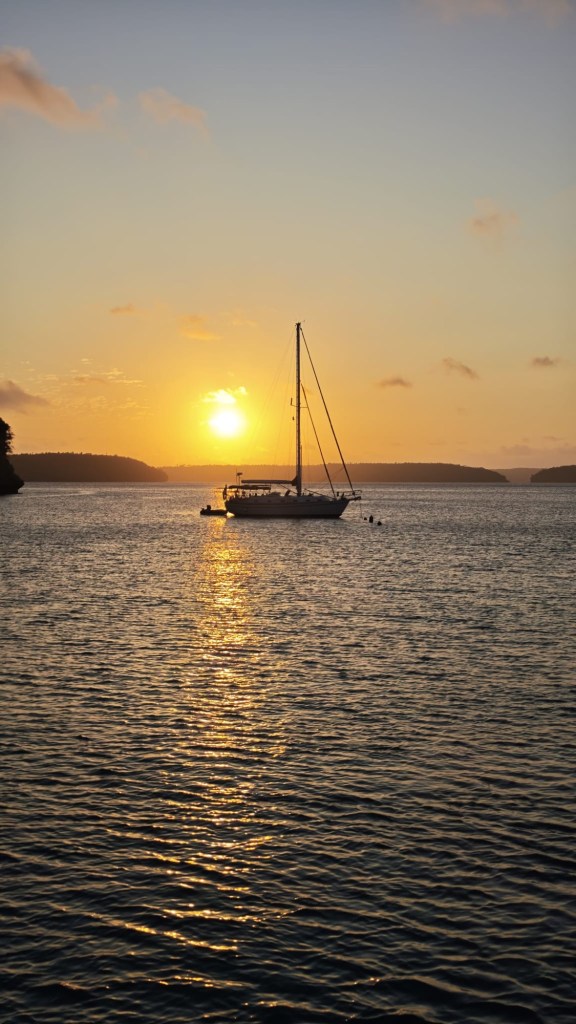
Anyway, around 14:00 I left Tonga behind.
The next three nights and two long days were spent at sea, making my way towards North Minerva Reef. Eventually, I reached the pass.
There was no reason to rush the final approach, especially as it was dark. The thought of entering in to an unknown reef was not an option for me. I hove to, setting the sails and rudder against each other so that the boat almost stopped, gently balancing herself against the ocean. I went below and slept for five hours.
When daylight came, I woke to find that Silke, aboard S/V Maiden Ocean, and the crew of Cloud Atlas had arrived.
Together, we motored through the pass and into North Minerva Reef.
Inside the reef, the ocean suddenly felt different; no swell. We dropped anchor among six other sailboats, surrounded by the vast Pacific and the broken ring of coral that makes North Minerva such a remarkable place.
After days at sea, there was something almost surreal about being there.
I was here.
I checked the anchor and had a bath.
I slept for five solid hours.
Silke on Maiden Ocean.
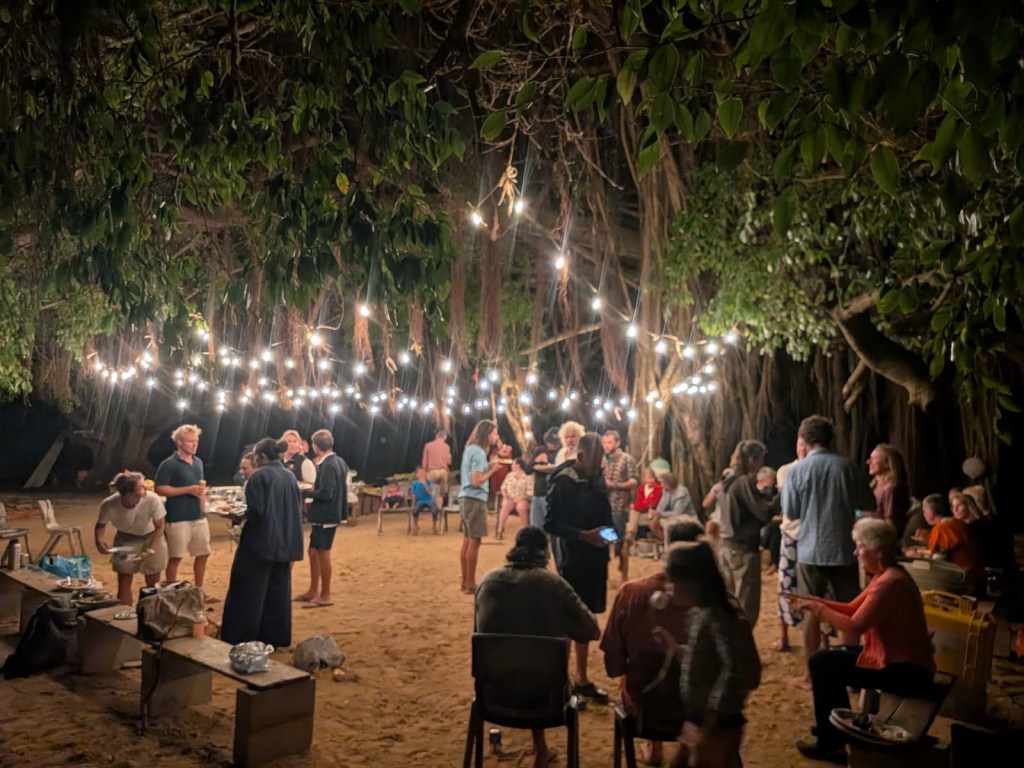
Silke, my neighbour, invited me aboard her boat to give thanks to Neptune. She opened a bottle of prosecco, and we spent the next couple of hours talking as the conversation unfolded easily between us.
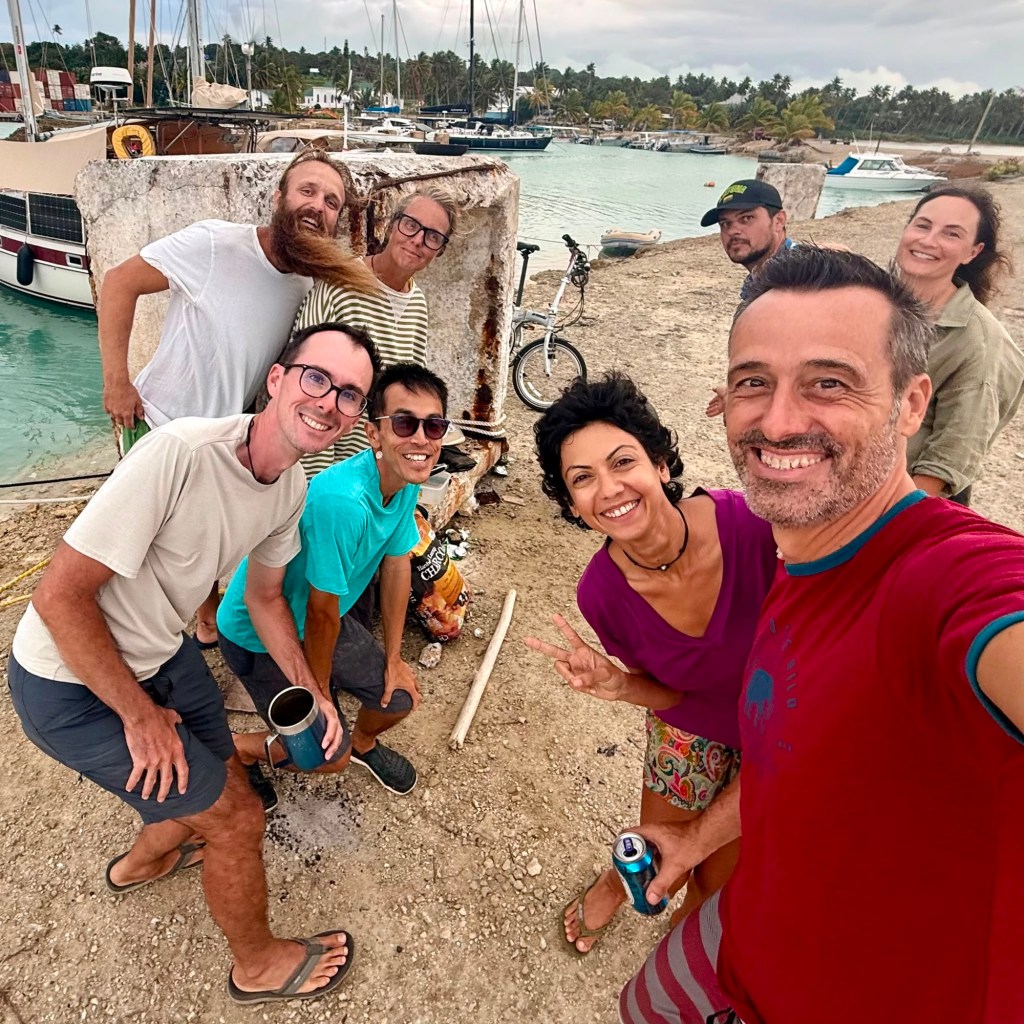
Silke is a solo sailor originally from South Africa. Sharing stories and comparing how we each arrived here remains one of my favourite things to do in life. There is something special about discovering the unexpected connections between people who have travelled such different paths. Often, the stories contain surprising similarities.
A week earlier, I had met a sailor from New Zealand aboard S/V Cloud Atlas. He told me that he had lived in Helsingborg, Sweden—not far from where I grew up—for a year. He had also spent several years in Campbell River, British Columbia, Canada, working as a photographer and filmmaker.
A large part of his story was remarkably similar to mine.
I checked out through customs, paid my port fees, and jumped on a taxi ferry back to Sarantium. I quickly tidied up, organized the deck, and finally pulled the anchor. I motored out through the channel of Tongatapu, zigzagging between the reefs as I made my way toward open water.
I had spent two months in Tonga, and as I watched the last island disappear behind me, I was left with the same feeling I always get when leaving an island group behind: a strange mixture of sadness and gratitude. There’s something about leaving an island behind that makes you realize just how much of a place has become part of you. You know you’re moving on, but a little piece of you feels like it’s staying behind.
I’m now two and half days away from Minerva Reef where I plan to stay for a few days! A few of the cruisers I’ve gotten to know, are also on their way there!
The track created by MET Bob who I hired to help with weather routing to New Zealand!Another reef!
After waiting for yet another part for the boat, it was finally time to get away from the city. Although it is handy to be at the dock, the constant noise of being on land has become something I am almost intolerant of.
The B&G WindSensor arrived in Nuku’alofa fairly quickly from New Zealand. I had been checking with the post office every other day, just so I wouldn’t miss it. And then, one day, it had indeed arrived.
What I didn’t know was that picking it up would be a full-day event. I wish I were exaggerating, but I am not.
I began the process at the post office at 8:30 in the morning. It wasn’t until 16:15 that I finally had the package in my hands—at the very same post office where I had started.
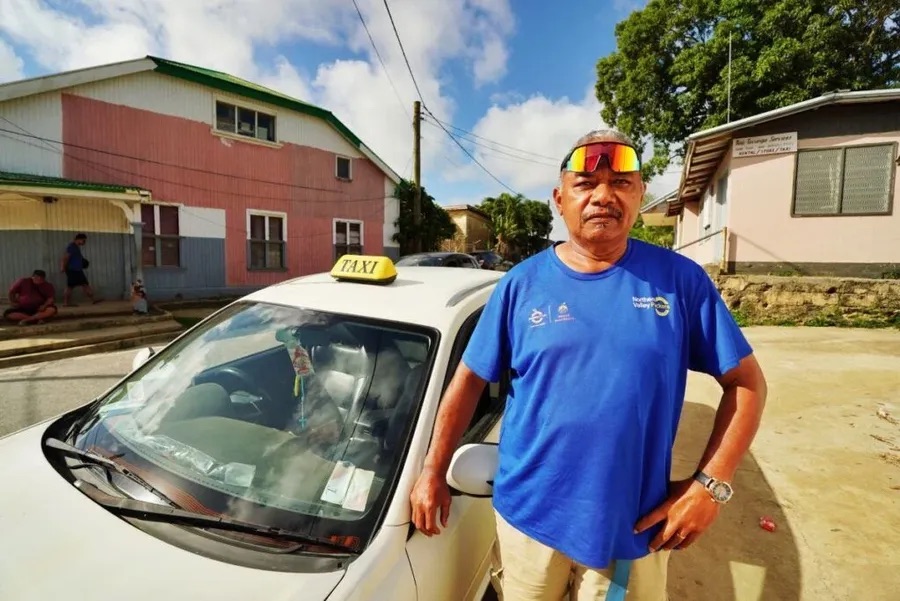
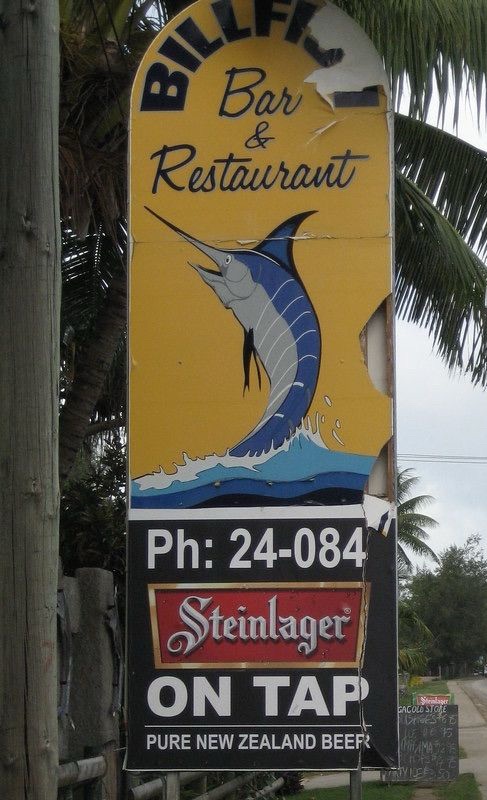
I had waved down a taxi to take me to the post office, and as it turned out, the taxi driver stayed with me for the entire day. This included lunch at “Billfish,” a popular bar in town. This was definitely the first time, in my life, I had wined and dined with my taxi driver.
Today I made a new best friend…
Not only did I get to know the driver, but I also learned a whole bunch about the political and economic aspects of Tonga, as well as its long history and culture. As it turns out, he learnt about receiving a package in his country. So, you might wonder: How does it possibly take seven hours to receive a small package?
I’m still gobsmacked by the whole day.
But here it goes.
I arrived at the post office, and they gave me a note and told me to take it to Customs.
Taxi ride across the city.
Customs said, “Get a broker.”…… every time we were told to go somewhere, my taxi driver would say in his charming Tongan accent “welcome to Tonga”!
Taxi ride to another corner of the city.
The Broker said, “Take this paper to Customs.”
Customs said, “Take this back to the Broker.”
The Broker said, “Take this back to Customs.”
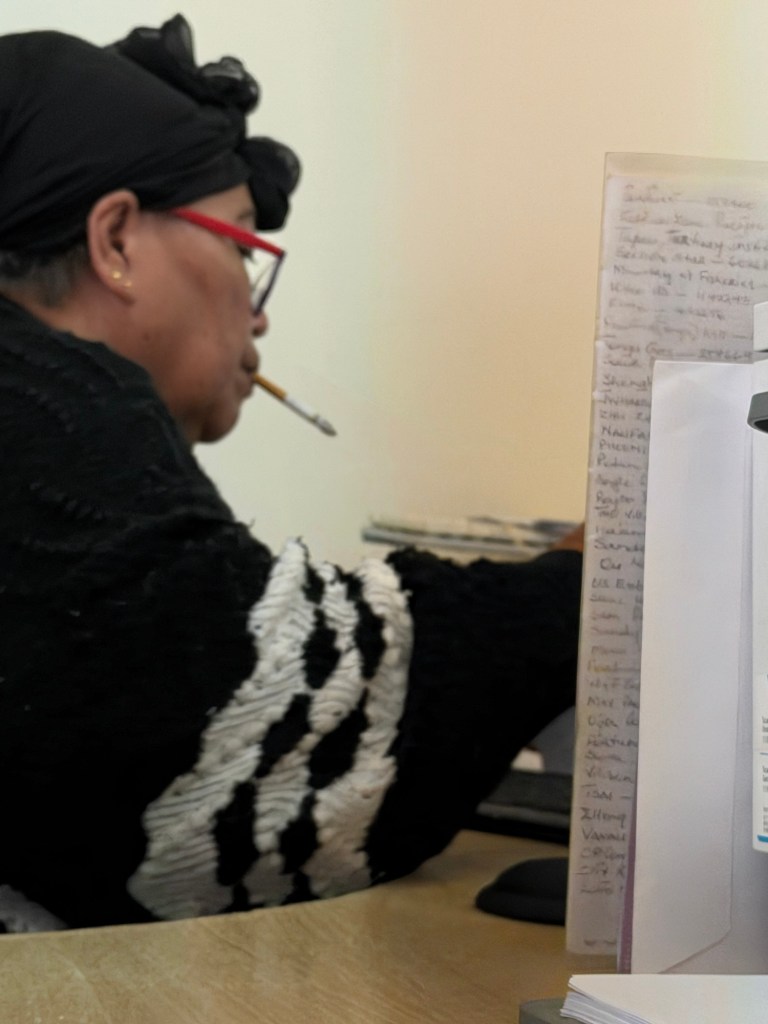
The Broker..love the vibe. At some point she was feeding me food…. while sucking on her cig.
This continued about five more times, before they said, ”you need a temporary import number, go to Ministry of Revenue”.
A taxi ride to yet another office.
Then, all of a sudden, they said, “Now go back to the post office, where they will inspect the package.”
The post office said, “It’s already been inspected at the airport, but now go to DHL and get a signature.”
For kicks, apparently.
DHL had nothing to do with the package, so I’m still not entirely clear on what they were supposed to do.
Then it was back to the broker, followed by a final interview with customs, before—finally—I went back to the post office to actually pick up the package, just 15 minutes before they closed.
After all this, I was sure I would be left with a massive bill, presumably so everyone involved could get paid.
But all they wanted was 21.40 Tongan Pa’anga—about 8 US dollars.
I’m not entirely sure how these people make their money….
Tuesday looks good to begin the final journey to New Zealand💨⛵️….🇳🇿
In the meantime, I’ll enjoy the little island outside of Nuku’alofa, the capitol of Tonga-where I’m anchored.
So many sea miles from Nanaimo, BC, to the capital of the Kingdom of Tonga—and now I’m just one leg away from New Zealand.
When I think back to Mexico, it felt like such a big feat. French Polynesia felt even bigger. And now, somehow, I’m here, just a few days away from making landfall in New Zealand.
I’m still trying to wrap my head around what I’ve actually done. All those miles, all those places, all the days and nights at sea… it’s hard to take it all in.
I wish I had the words to describe what this feels like, but I don’t. Maybe one day I will.
For now, I’m just sitting with it, feeling incredibly grateful, and looking back at the miles behind me with a sense of wonder. I never imagined I’d come this far.
Somewhere in the Kingdom of Tonga …
Even though sailing my boat from country to country, island to island, is the main focus here, there is so much more I could share. In writing, I’ve touched on the people I’ve met, the cultures I’ve experienced, the events I’ve faced, the challenges I’ve overcome, and the knowledge I’ve gained. What I haven’t shared, or perhaps haven’t yet found the words for, is the personal growth I’ve felt along the way—the things I’ve worked through, the things I’ve let go of, and the things I’ve left behind in each bay where my anchor touched the sand.
Even now, the journey is still teaching me. Every day, I discover something new about myself, and every day there is something I quietly promise myself I won’t do again. Perhaps one day I’ll have the time, and the courage, to give those lessons the details they deserve, in writing. For now, they remain part of the wake behind me—stories, mistakes, fears, and small victories.
And maybe that is what this journey has really been about: not simply sailing far enough to see the world, checking off countries, but going far enough to meet the person I am becoming.
The past month has been quite a roller coaster, with more flights than I care to count and countless hours spent crossing oceans and continents. From getting to Tonga, to travelling all the way from Vava’u to Italy via New Zealand and Australia, it has been a month filled with contrasts, wonderful memories, and a few unexpected adventures.
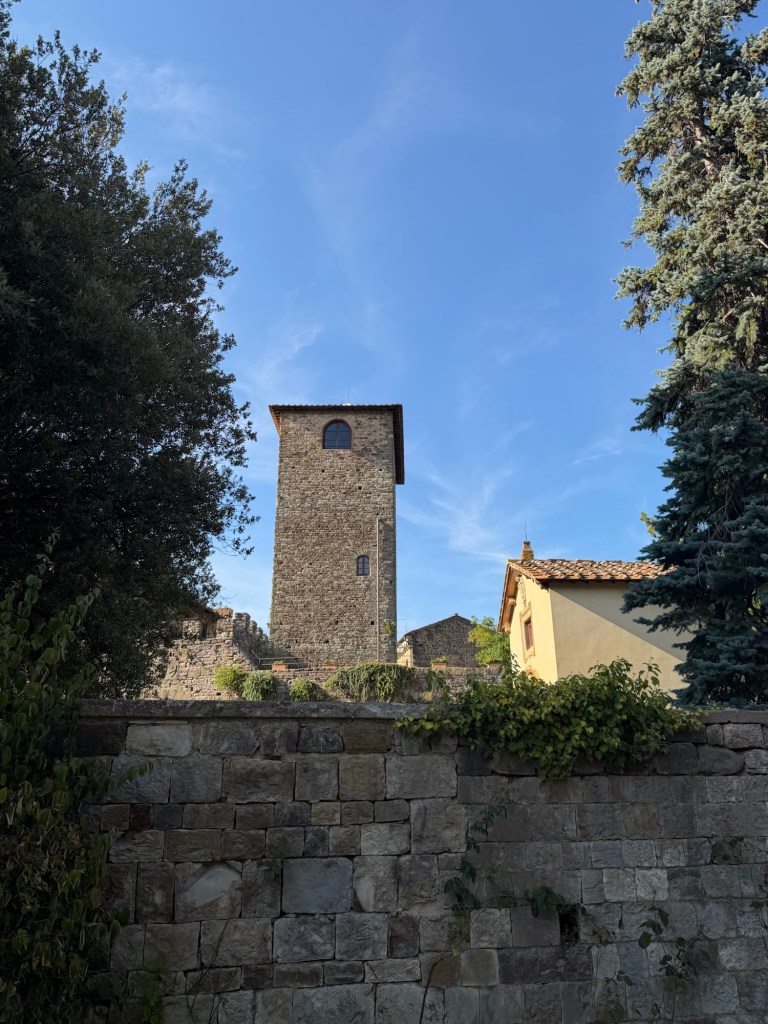
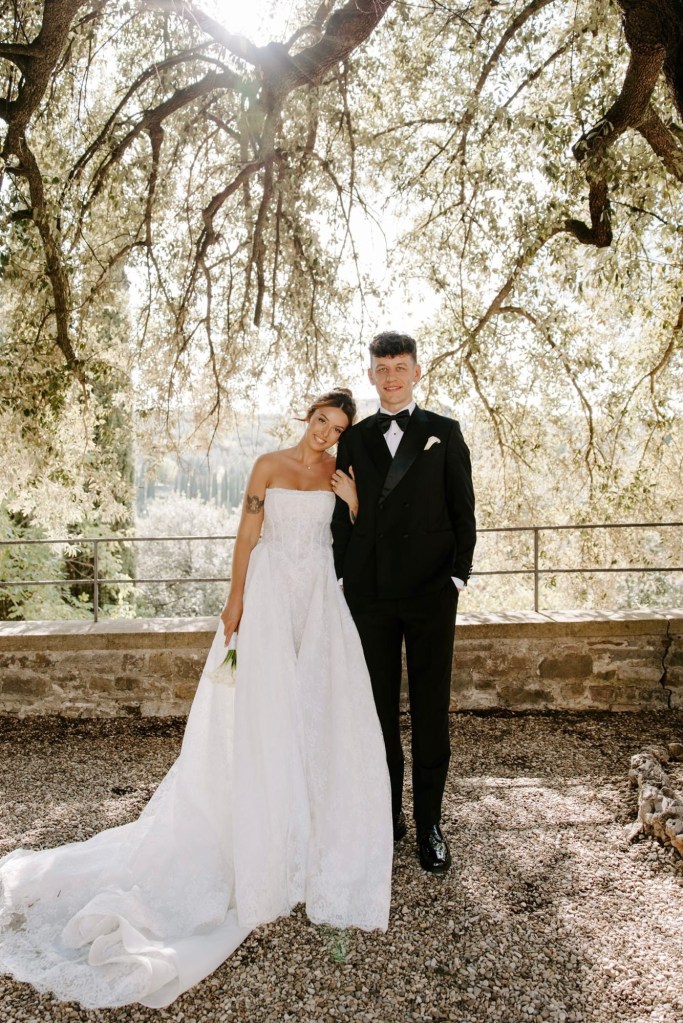
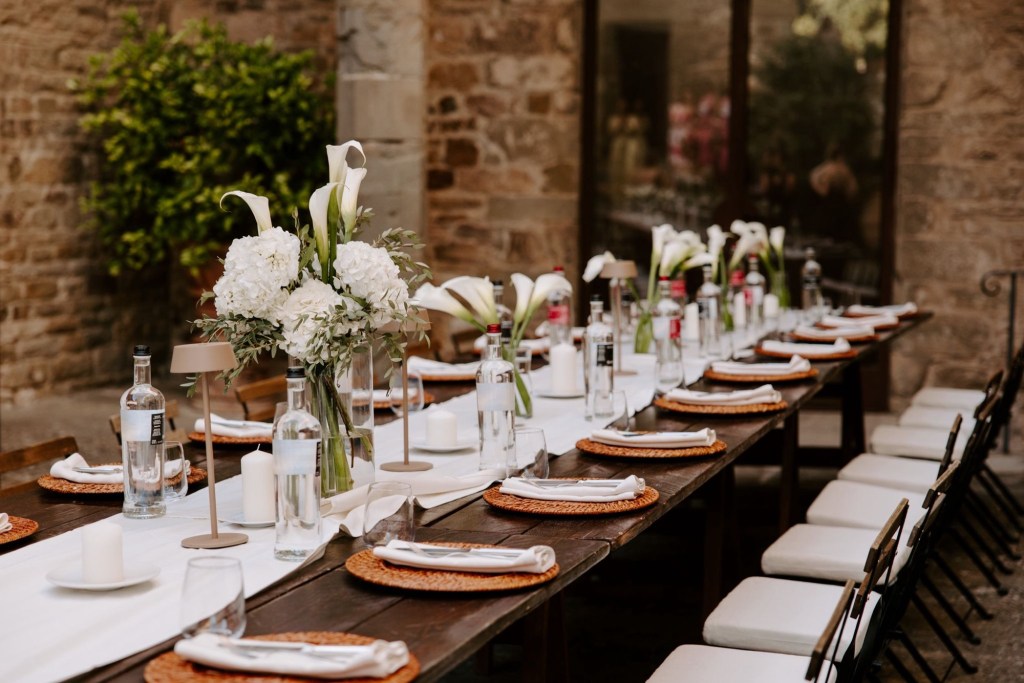
The highlight, without a doubt, was my daughter’s wedding in Tuscany. It was simply magnificent. The venue was a charming little castle, built in the early 1200s and surrounded by the vineyards of the Chianti region. Thirty-five guests gathered there, half travelling from Canada and the other half from the UK. Having everyone together in such a beautiful and historic setting made the occasion feel almost magical. It was one of those moments you know you will carry with you for the rest of your life.
Then came the journey home.
Travelling back from Italy was a bit of a trek, and somehow I found myself flying from Fiji to Tonga not once, but twice. The first flight left Fiji in good weather, but as we approached Tonga, everything changed. Strong westerly winds and heavy rain made the landing too difficult. After two attempts, the pilot pulled the plane back above the clouds and made the decision to return to Fiji.
Safety first.
At the time, of course, it was frustrating. But looking back, perhaps things do happen for a reason.
About 30 of us ended up at a small motel in Fiji, where Fiji Airways arranged a late dinner. What could have been a rather disappointing evening turned into something quite memorable. I found myself sitting around a table with people from different parts of Europe, all of us sharing the same unexpected adventure. There was something comforting about being amongst strangers who, for one night, were all in the same boat—or, perhaps more appropriately, the same plane!
The following morning, we were taken back to the airport and set off for Tonga once again. This time, the landing was smooth and uneventful.
Home sweet home.
After so much travelling, it felt especially good to be back. There is something about returning to the boat and to the familiar rhythm of island life that makes all the miles suddenly worthwhile.
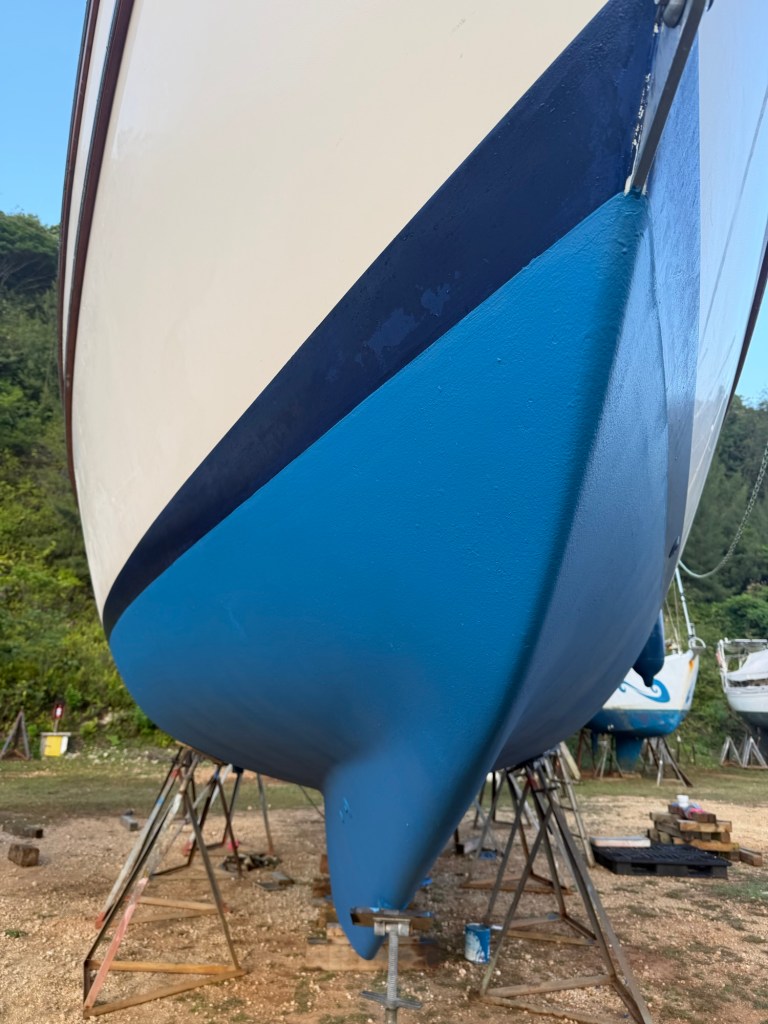
Clean bottom… ready for the crossing to NZ.
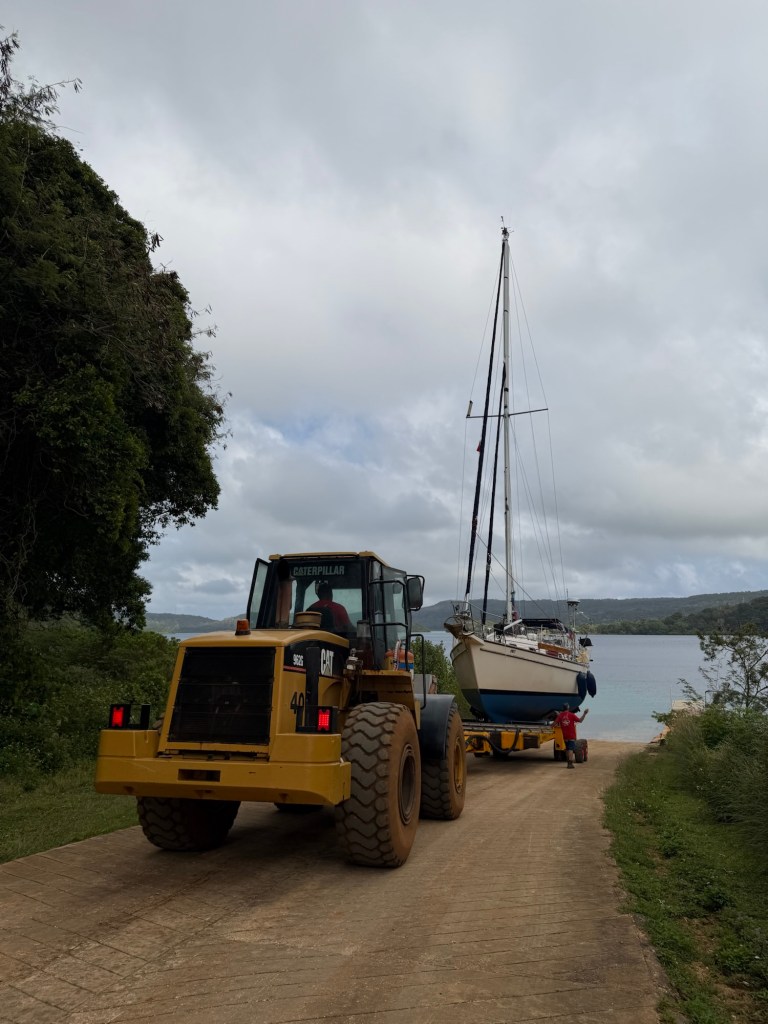
The past few days have been spent getting the boat ready for the next chapter. She has been hauled up, the bottom painted, and all the little jobs and odds and ends that somehow accumulate have been taken care of. Now the focus is shifting once again to sailing.
The plan is to spend some time cruising through the Tongan island groups before heading towards Minerva Reef. There, we’ll take a little time to rest, snorkel and enjoy the solitude before setting off on the final crossing to New Zealand.
After the whirlwind of the past month, I’m looking forward to slowing down again—to the sea, the wind, the islands and the simple pleasure of being back where I feel most at home.